Hello, friends!
I’m back. For the moment at least. I originally conceived this blog as a way for current and prospective clients to get a sense of my personality. It's so difficult to communicate to another person what you're like, who you are, to give them a sense of whether you'd vibe together in the context of therapy. I figured one way to get a sense of who a person is, is to get their takes on various dimensions of our culture. And so if you tend to like some of the same things I like, it stands to reason that we might have some other things we could find common ground on. Like most self-selected professional commitments, blogs tend to come and go depending on whether life's current season can make room for them, but I'm still convinced this particular medium is a valuable one for me to share my thinking on things and giving fellow travelers the sort of peek into my experience that therapy does not have space for. I can’t say I’ll be posting every week, but I’d like to pop one off more than once a year.
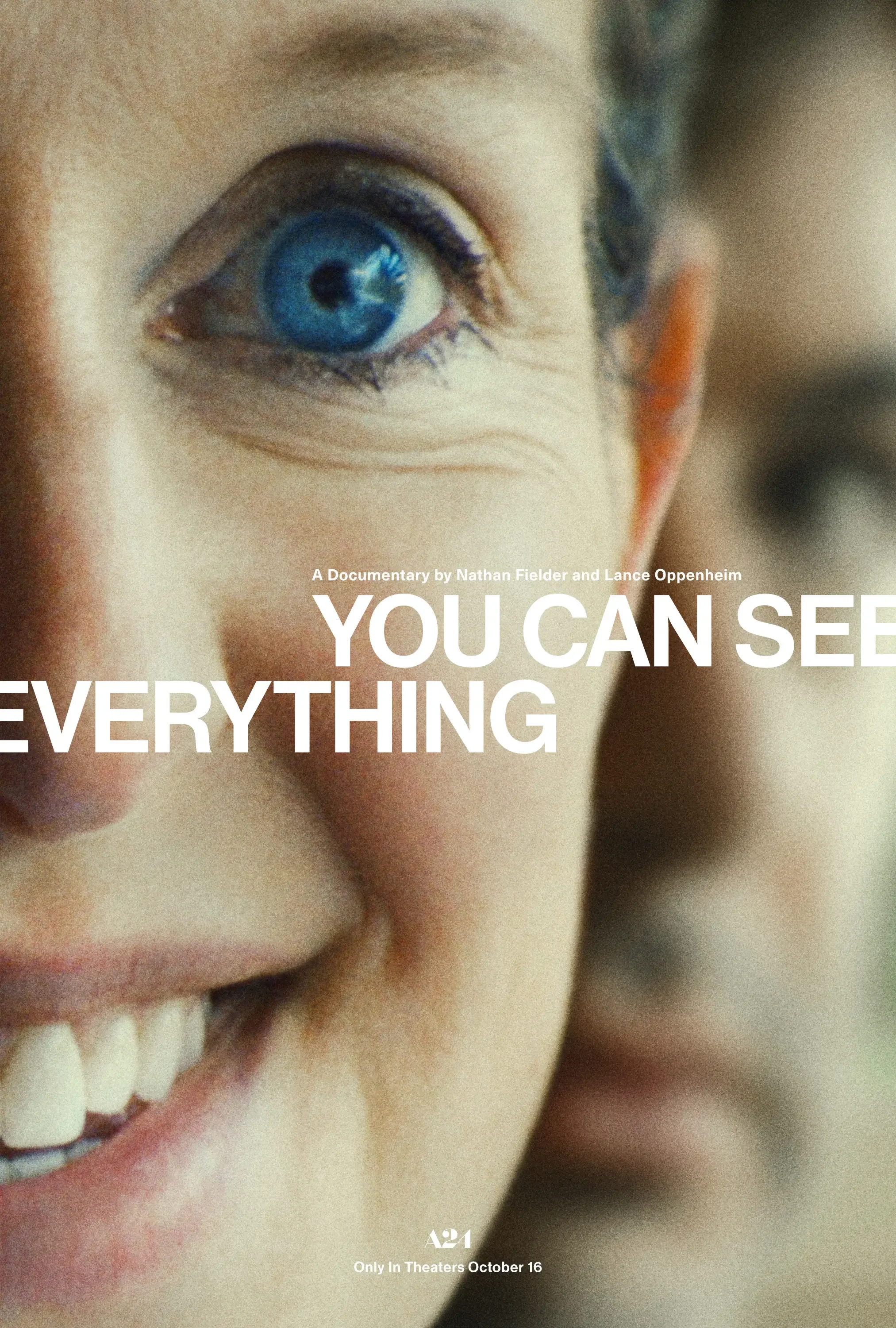
Now, onto my thoughts on You Can See Everything.
Truth, Reality, and the Self
That was the name of a philosophy class I took in high school. I mostly remember reading a lot of interesting books, like Life of Pi and Zen and the Art of Motorcycle Maintenance. But the title has sometimes felt relevant as a way to describe certain kinds of novels are film. You Can See Everything, directed by Nathan Fielder and Lance Oppenheim, is in the “truth, reality, and the self” genre. It is “about” Elizabeth Holmes, the Silicone Valley founder and convicted fraudster. It is ostensibly “about” who she really is (as opposed to who the media has made her out to be).
But because of Fielder and Oppenheim chose to film You Can See Everything with Fielder as a subject navigating the murky, pre-prison sentence world Holmes inhabited, this is also a movie about the difference between truth and reality.
The film considers whether who Elizabeth Holmes believes she is tells us anything about who she is in reality. We primarily observe this consideration through Fielder, whose face mostly reads “are you sure you don’t want to admit you’re bullshitting me” for the first 90 minutes before switching to “am I sure I’m not bullshitting myself” for the last 90.
Let’s say you and I are in a room. You’d like to invest 1 billion dollars into my red apple, which is in this opaque box only I can see inside. I assure you it’s red. You give me 1 billion dollars but after investigating, you learn the apple is green. You Can See Everything wonders if my red/green colorblindness changes how
I think Fielder and Oppenheim want to know how we decide what is real. There is a version of reality that is real to Holmes, who is trying to grapple with the reality going to prison and leaving her husband and two small children. There is the reality of said husband, Billy Evans, who seems more interested in Elizabeth Holmes as a resource than as a partner. There is the reality of Fielder, who seems genuinely eager in finding the truth. We’re even treated to the version of reality of Amanda Seyfried, the actress who portrayed Holmes in the 2022 hulu show The Dropout.
Fielder and Seyfried both struggle to determine the degree of Holmes’s deception, self or otherwise. They are both grossed out by Evans’s whole vibe, which seems in turns delusional, narcissistic, abusive, and calculating.
T.S. Eliot said: “We die to each other daily. What we know of other people is only the memory of the moments during which we knew them.” A lot of my work with clients is focused on helping them cultivate the skill of knowing every part of who they are. The parts of themselves they like, the parts the don’t like, and the parts that are so much a part of our daily lived lives that we don’t even see they’re there anymore.
But here’s the hard part. Not a single one of those parts, or any combination of them, actually gives you any sense of who you are. Are you your memories? Your sensations? Your wounds? All of that? More? If we look hard enough we’ll see that there is no stable self to actually find. Not for myself, not for the sense of who others are.
Who is Elizabeth Holmes? The central argument of this film is that a lot of people, from Amanda Seyfried to Billy Evans, believe they have some authority with which to answer the question. What I think Fielder and Oppenheim learn is that anyone who says they can tell you who Elizabeth Holmes is probably selling you something.
The same is true for you and I.
Anyway, those are my thoughts after coming home from the theater. There may be a part II. Know yourself, love yourself, and maybe loosen your grip on who you think you are. -j